Both splash aerators and paddle wheel aerators increase dissolved oxygen by moving pond water into contact with atmospheric air. However, they create different water-flow patterns and are generally suited to different pond sizes, layouts, and farming conditions.
A splash aerator pushes water upward and disperses it around the machine. It is compact, lightweight, and well suited to localized oxygenation in tanks, nursery ponds, and small or medium-sized ponds.
A paddle wheel aerator uses rotating paddles to throw water across the surface while creating a stronger horizontal current. It is commonly selected for commercial fish and shrimp ponds where broader circulation is required.
The quick answer is:
Choose a splash aerator when you need compact, localized surface aeration. Choose a paddle wheel aerator when you need stronger horizontal circulation across a larger pond.
Neither design is automatically better. The correct choice depends on pond dimensions, water depth, stocking density, expected biomass, circulation requirements, available power, and maintenance conditions.
| Comparison | Splash Aerator | Paddle Wheel Aerator |
|---|---|---|
| Primary water movement | Upward and outward | Horizontal across the surface |
| Typical circulation area | Concentrated around the unit | Broader directional flow |
| Structure | Compact, often with one float | Multiple floats, shafts, and paddles |
| Installation | Relatively simple and easy to reposition | Requires more assembly and pond space |
| Typical pond type | Tanks, nursery ponds, small and medium ponds | Medium and large commercial ponds |
| Common applications | Fish tanks, tilapia ponds, localized aeration | Shrimp ponds, fish ponds, intensive aquaculture |
| Number of moving components | Generally fewer | Generally more |
| Water-flow control | Localized mixing | Stronger directional circulation |
| Main selection advantage | Compactness and flexibility | Wider pond circulation |
| Potential limitation | Limited horizontal coverage | Larger footprint and more mechanical parts |
Surface aerators can create either vertical or horizontal currents while discharging water into the air, improving oxygen transfer and the pond's oxygen balance.
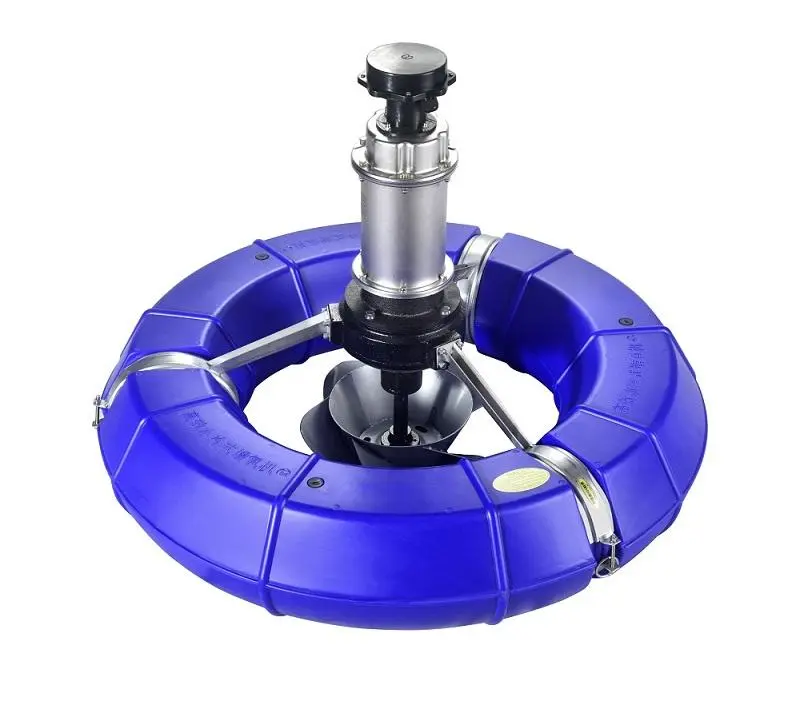
A splash aerator uses a high-speed impeller to lift water above the pond surface. The water breaks into droplets before falling back into the pond, increasing the contact area between water and atmospheric air.
The movement is mainly concentrated around the aerator. Depending on the impeller design, it may resemble a fountain, upward surge, or circular splash pattern.
Flojett's splash aerator range includes water-cooled splash aerators, water-cooled surge models, and super-impeller configurations. Flojett describes splash aerators as compact products for surface oxygenation in fish farming and other aquaculture applications.
The operating process is straightforward:
The motor rotates the impeller.
The impeller draws water upward.
Water is discharged above the surface.
The water separates into droplets and waves.
Oxygen transfers into the water as it contacts the air.
The oxygenated water returns to the pond and creates local mixing.
Flojett’s surface-aeration guidance describes its splash aerator as functioning like an upward fountain that moves lower-oxygen water into the air and breaks it into droplets for oxygen absorption.
Splash aerators may be suitable for:
Tilapia ponds and tanks
Fish nursery ponds
Small and medium grow-out ponds
Aquaculture tanks
Localized low-oxygen zones
Supplementary daytime or nighttime aeration
Small wastewater-treatment ponds
Emergency surface aeration
Their compact structure also makes them useful when equipment must be moved between tanks or pond zones.
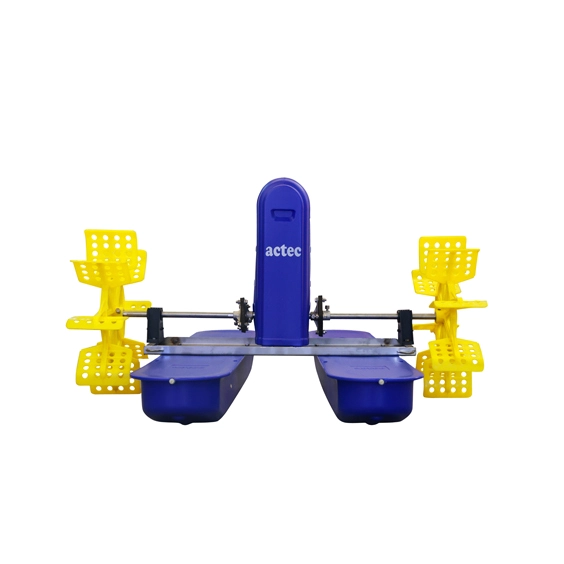
A paddle wheel aerator uses motor-driven paddles mounted on one or more horizontal shafts. As the paddles rotate, they strike and lift surface water, creating splashing and a strong directional current.
The aerator therefore performs two closely related functions:
It increases contact between water and air.
It moves oxygenated water horizontally across the pond.
Paddle wheel aerators are among the most commonly used mechanical aerators in pond aquaculture. Smaller designs of approximately 1.5 kW or less have historically been widely used in marine shrimp culture.
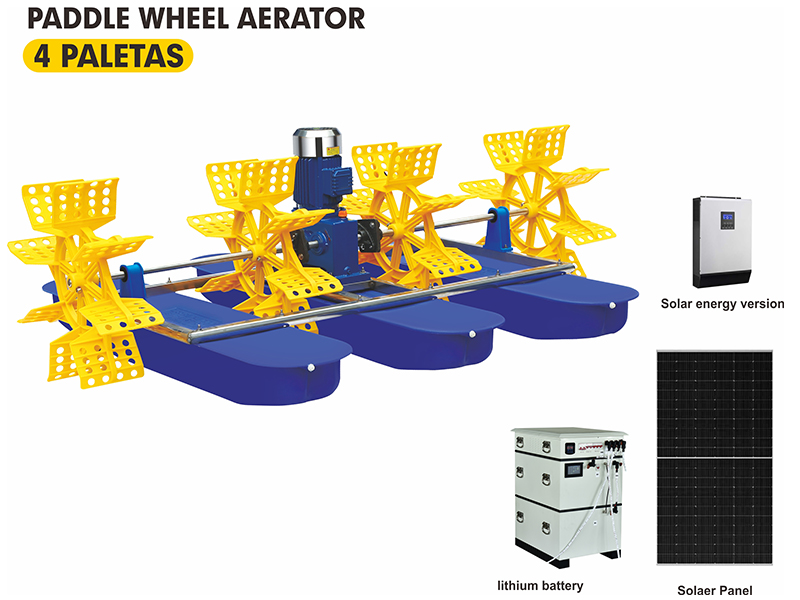
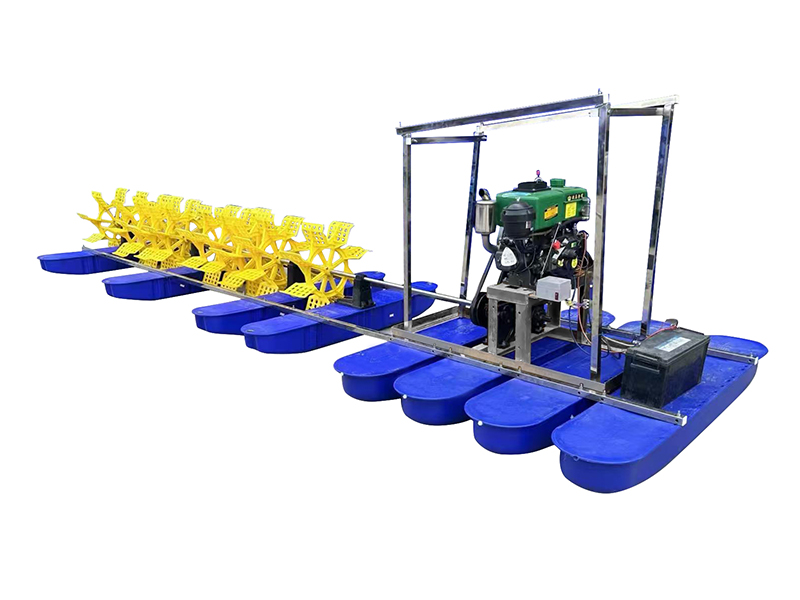
Flojett offers a broad paddle wheel aerator range, including 1 HP, 2 HP, 3 HP, multi-impeller, permanent magnet, diesel-powered, and solar-powered configurations.
The basic operating process is:
The motor transfers power through the gearbox.
One or more shafts rotate the paddle wheels.
The paddles lift and throw surface water into the air.
Water droplets absorb oxygen before returning to the pond.
Continuous paddle movement generates a directional surface current.
The current distributes oxygenated water and reduces stagnant zones.
Paddle wheel design, paddle immersion depth, rotational speed, and overall mechanical design can all influence oxygen-transfer efficiency.
Paddle wheel aerators are commonly considered for:
Commercial shrimp ponds
Fish grow-out ponds
Medium and large aquaculture ponds
High-density stocking systems
Ponds requiring directional circulation
Water movement around central drains
Emergency aeration in production ponds
Wastewater lagoons and equalization ponds
They are especially useful where aeration must also create a defined horizontal flow pattern.
The most important difference between the two designs is not simply horsepower or oxygen output. It is the direction and coverage of water movement.
A splash aerator moves water primarily upward before it falls around the machine. This creates intensive agitation near the installation point.
It may therefore be effective when:
The pond or tank is relatively small.
Oxygenation is needed in a specific area.
The machine must occupy limited space.
The operator wants equipment that is easy to reposition.
Strong long-distance horizontal flow is not the main objective.
A paddle wheel aerator pushes water across the pond surface. Several units can be positioned to create a consistent circular current.
This may be more useful when:
The pond has a larger surface area.
Water must move around the entire pond.
The farm needs to reduce stagnant corners.
Sludge movement toward a collection zone is part of the pond design.
High shrimp or fish biomass requires distributed aeration.
Large paddlewheel systems can move substantial volumes of water while producing strong currents, illustrating why this aerator type is often selected where broad circulation is important.
A common purchasing mistake is to assume that two aerators with the same motor power will deliver identical oxygenation.
Actual performance may depend on:
Impeller or paddle design
Impeller diameter
Number of paddles
Paddle immersion depth
Motor efficiency
Gearbox losses
Rotational speed
Water temperature
Salinity
Initial dissolved oxygen level
Installation position
Pond depth
Maintenance condition
For example, Flojett lists the following rated specifications for selected models:
| Flojett Model | Aerator Type | Rated Power | Listed Aeration Capacity | Unit Weight |
|---|---|---|---|---|
| FJ-WC1.5 | Water-cooled splash aerator | 1.5 kW / 2 HP | ≥2.4 kg O₂/h | 33 kg |
| FJ-WC2.2 | Water-cooled splash aerator | 2.2 kW / 3 HP | ≥4.3 kg O₂/h | 34 kg |
| FJ-WS | Water-cooled surge aerator | 1.5 kW / 2 HP | ≥2.6 kg O₂/h | 33 kg |
| FJ-PW204 | Four-impeller paddle wheel aerator | 1.5 kW / 2 HP | ≥2.6 kg O₂/h | 100 kg |
| FJ-PW306 | Six-impeller paddle wheel aerator | 2.2 kW / 3 HP | ≥3.5 kg O₂/h | 125 kg |
The data show that the listed oxygenation capacity cannot be predicted from horsepower alone. A 3 HP splash model and a 3 HP paddle wheel model may have different rated capacities because their structures and test conditions differ. Flojett lists these figures on the relevant product pages.
These values should still be confirmed against the supplier’s testing method. Actual performance in a working pond can vary with water quality, temperature, salinity, installation, and operating conditions.
A splash aerator is often the more practical option for a small pond, nursery pond, or tank.
Its advantages include:
Compact dimensions
Lower unit weight
Fewer structural components
Convenient installation
Easy movement between locations
Concentrated surface agitation
Limited pond-space requirement
The Flojett FJ-WC and FJ-WS series weigh approximately 33–34 kg, while the listed FJ-PW204 2 HP paddle wheel aerator weighs 100 kg. This illustrates the installation and handling difference between the two structures.
However, a small pond with a long, narrow shape may still benefit from a paddle wheel aerator if directional water movement is more important than compactness.
A paddle wheel aerator is generally more suitable when the primary goal is broad horizontal circulation across a medium or large pond.
Multiple paddle wheel units can be installed around the perimeter and directed in the same rotational direction. This can help establish a circular flow pattern and distribute aerated water across a wider area.
A paddle wheel aerator may therefore be preferred when:
The pond is large or elongated.
Shrimp or fish biomass is high.
Water circulation must reach distant pond zones.
The farm wants to guide solids toward a central area.
Several aerators will be operated as one circulation system.
Emergency oxygenation must cover a larger production pond.
Flojett offers standard models with 2, 4, 6, and 8 impellers, as well as longer multi-impeller systems for larger pond applications.
For many commercial shrimp ponds, paddle wheel aerators are the more common primary surface-aeration choice because they combine oxygen transfer with directional water circulation.
Their horizontal flow can help:
Distribute oxygenated water
Reduce isolated low-flow zones
Maintain continuous pond circulation
Support higher production biomass
Influence the movement of suspended solids
However, a splash aerator may still be useful in shrimp farming as:
A supplementary aerator
A localized aerator near weak-flow areas
An aerator for nursery tanks
A movable emergency unit
A solution for smaller lined ponds
In some farms, the best system is not one type or the other. Paddle wheel aerators can provide the primary circulation pattern, while splash aerators supply additional oxygenation in specific zones.
The correct choice depends heavily on pond dimensions and fish-production intensity.
A splash aerator may be appropriate for:
Tilapia tanks
Small fish ponds
Nursery ponds
Localized aeration
Systems where equipment must be moved frequently
A paddle wheel aerator may be more appropriate for:
Larger grow-out ponds
High-density fish production
Long rectangular ponds
Ponds requiring continuous surface circulation
Farms using multiple coordinated aerators
Flojett identifies splash aerators as suitable for small-scale fish farming and paddle wheel aerators as a conventional option for maintaining dissolved oxygen in fish and shrimp farming.
A typical splash aerator uses one float or compact support structure. It is normally positioned where localized surface agitation is needed.
Installation considerations include:
Adequate water depth around the impeller
Secure electrical connection
Sufficient clearance from pond banks
Protection against debris
Easy access for inspection
Stable anchoring or positioning
Because the aeration zone is relatively concentrated, more than one unit may be required if a large pond has several low-flow areas.
A paddle wheel aerator normally requires:
Multiple floats
A motor and gearbox
One or more shafts
Paddle wheels or impellers
A supporting frame
Anchoring ropes or positioning hardware
The direction of installation matters. Units should work together rather than create opposing currents.
Poor positioning can cause:
Dead zones
Conflicting water currents
Bank erosion
Uneven oxygen distribution
Unwanted sludge accumulation
Splash aerators usually have a compact structure and fewer external mechanical parts. Depending on the model, routine checks may include:
Impeller condition
Motor protection
Float damage
Stainless steel support components
Electrical cable condition
Debris accumulation
Fasteners and mounting points
Flojett’s FJ-WC model is designed without a gearbox, eliminating the need for gear oil and reducing the number of related maintenance points.
Paddle wheel aerators generally include more transmission and structural components. Routine inspection may cover:
Gearbox oil and seals
Bearings
Shafts
Paddle wheels
Couplings
Frames
Floats
Fasteners
Motor protection
Electrical connections
The larger number of components does not make a paddle wheel aerator unsuitable, but it means maintenance access and spare-parts availability should be considered before purchase.
Purchase price is only one part of the total operating cost. Aquaculture aerators may run for extended periods, particularly at night, during hot weather, or near the end of the production cycle.
When comparing equipment, buyers should evaluate:
Rated motor power
Motor efficiency
Tested oxygen-transfer performance
Daily operating hours
Local electricity price
Maintenance frequency
Spare-parts cost
Expected service life
Backup-equipment requirements
Flojett offers high-efficiency motors, permanent magnet motor options, and solar-powered configurations across parts of its aerator range. The company positions these options as ways to reduce energy use and long-term operating costs.
A lower-power unit is not necessarily more economical if several additional machines are required to achieve the same circulation and oxygenation objectives.
Yes. A combined setup may be appropriate when the pond requires both broad circulation and additional localized oxygenation.
A possible arrangement is:
Paddle wheel aerators around the pond perimeter to establish directional flow
Splash aerators in nursery sections, corners, or isolated low-oxygen areas
Dissolved oxygen sensors at several points and depths
Backup aerators for equipment failure or severe weather
Bottom aeration where deeper oxygen distribution is required
The right aquaculture aerator system may therefore include more than one aerator type. Flojett’s product range includes paddle wheel, splash, and jet aerators for different surface and subsurface water-movement requirements.
Use the following questions before deciding between a splash aerator and a paddle wheel aerator.
Is the pond, tank, or nursery area relatively small?
Is localized oxygenation more important than long-distance circulation?
Does the equipment need to be moved regularly?
Is installation space limited?
Is a compact, lightweight design preferred?
Is the unit intended as supplementary or emergency aeration?
Is the pond medium or large?
Is strong horizontal water circulation required?
Does the pond have stagnant corners?
Is the system intended for commercial shrimp production?
Must water flow guide solids toward a collection zone?
Will multiple aerators operate together around the pond?
Is broader oxygen distribution required?
The pond is large but has localized low-oxygen zones.
Nursery and grow-out areas share the same site.
Biomass and feeding rates are high.
Emergency aeration flexibility is important.
Surface circulation and bottom aeration are both needed.
To receive a useful aerator recommendation, provide the supplier with:
Pond length and width
Average and maximum depth
Pond shape
Fish or shrimp species
Stocking density
Expected harvest biomass
Daily feeding rate
Water salinity
Existing aeration equipment
Local voltage and frequency
Required operating hours
Preferred equipment quantity
Destination country or port
Flojett can use this information to compare suitable splash and paddle wheel aerator models rather than recommending equipment based only on motor horsepower.
Not in every situation. A splash aerator is usually more suitable for compact installation and localized oxygenation, while a paddle wheel aerator is generally more suitable for broad horizontal circulation in medium or large ponds.
A splash aerator mainly lifts water upward and distributes it around the machine. A paddle wheel aerator uses rotating paddles to create stronger directional flow across the pond surface.
Paddle wheel aerators are commonly selected as the primary surface aerator for commercial shrimp ponds because they provide both oxygen transfer and horizontal circulation. Splash aerators can supplement weak-flow areas, nursery tanks, or smaller ponds.
Splash aerators often have fewer external mechanical components, particularly gearbox-free designs. Paddle wheel aerators contain additional shafts, paddles, bearings, and transmission components, although maintenance requirements vary by model and construction quality.
Yes, but one unit may provide only localized aeration. A large pond may require several splash aerators or a combined system. A paddle wheel aerator may be more effective where broad directional circulation is required.
Yes. Paddle wheel aerators can create the main circulation pattern, while splash aerators provide supplementary oxygenation in selected zones. The arrangement should be verified through dissolved oxygen monitoring and observation of pond currents.
The choice between a splash aerator and a paddle wheel aerator should be based on water movement, pond layout, oxygen demand, and operating conditions—not on product name or horsepower alone.
A splash aerator is generally the better option for:
Tanks and nursery systems
Small or medium ponds
Localized oxygenation
Compact installation
Equipment that must be easy to reposition
A paddle wheel aerator is generally the better option for:
Medium and large ponds
Commercial shrimp farming
Strong horizontal circulation
Higher production biomass
Multiple-unit circulation layouts
For some farms, a combined system provides the best result. Paddle wheel aerators can manage broad surface circulation, while splash aerators strengthen oxygenation in localized areas.
Flojett supplies splash, paddle wheel, surge, jet, permanent magnet, diesel, and solar aeration configurations. Send Flojett your pond dimensions, species, stocking density, expected biomass, local power supply, and operating requirements to receive a suitable model recommendation and project-based quotation.


 English