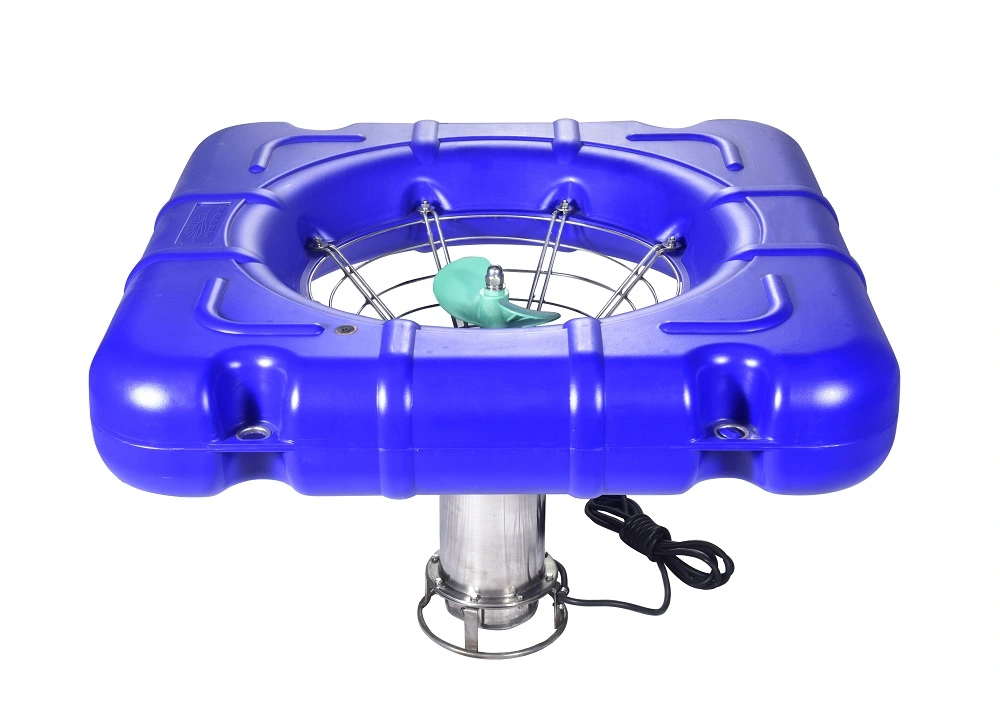
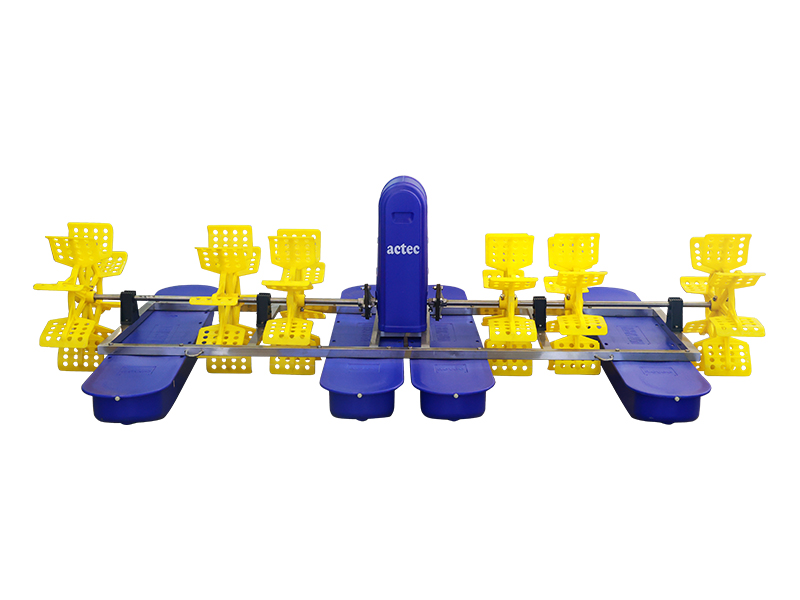
For most shrimp ponds, the number of paddle wheel aerators required per hectare cannot be determined by pond area alone. A low-density pond may operate with only a few horsepower of mechanical aeration, while an intensive shrimp pond with high expected biomass may require 20 HP per hectare or more.
A practical starting guideline is:
Install approximately 1 HP of mechanical aeration for every 400–500 kg of expected shrimp harvest biomass.
Using this guideline, a pond targeting 5,000 kg of shrimp per hectare may require approximately 10–12.5 HP of installed aeration capacity. If 2 HP paddle wheel aerators are selected, this equals roughly five to seven units per hectare.
However, this is only a planning estimate. Final aerator quantity should also consider pond depth, stocking density, feeding rate, water temperature, salinity, circulation pattern, aerator efficiency, and emergency backup requirements.
The table below provides a practical starting range based on expected harvest biomass.
Expected Shrimp Harvest | Suggested Aeration Capacity | Approx. Number of 1 HP Aerators | Approx. Number of 2 HP Aerators |
2,000 kg/ha | 4–5 HP/ha | 4–5 units | 2–3 units |
3,000 kg/ha | 6–7.5 HP/ha | 6–8 units | 3–4 units |
5,000 kg/ha | 10–12.5 HP/ha | 10–13 units | 5–7 units |
8,000 kg/ha | 16–20 HP/ha | 16–20 units | 8–10 units |
10,000 kg/ha | 20–25 HP/ha | 20–25 units | 10–13 units |
15,000 kg/ha | 30–37.5 HP/ha | 30–38 units | 15–19 units |
These values are calculated from the commonly cited guideline of approximately 1 HP per 400–500 kg of expected shrimp production. They should not be treated as guaranteed operating requirements because actual oxygen demand varies throughout the culture cycle.

It is tempting to ask for a simple answer such as “four aerators per hectare.” The problem is that two one-hectare shrimp ponds can have very different oxygen requirements.
For example:
Pond A may be stocked at a moderate density and target 3,000 kg/ha.
Pond B may use intensive vannamei production and target 10,000 kg/ha.
Pond C may use biofloc, continuous feeding, and limited water exchange.
Pond D may be shallow, lightly stocked, and supported by natural photosynthesis.
Although all four ponds have the same surface area, their required aeration capacities are not the same.
Paddle wheel aerators do more than add oxygen. They also create horizontal water movement, reduce stagnant areas, limit stratification, and help direct suspended solids toward collection zones. These circulation functions make aerator placement almost as important as total horsepower.
Flojett offers several paddle wheel aerator configurations for shrimp ponds with different power, impeller, and motor requirements.
A better way to estimate paddle wheel aerator requirements is to calculate from expected maximum shrimp biomass.
Use the following planning formula:
Required aeration capacity in HP = expected harvest biomass in kg ÷ 400–500
This produces a range rather than one exact number.
Suppose a one-hectare pond is expected to produce 4,000 kg of shrimp.
Using the conservative side of the guideline:
4,000 ÷ 400 = 10 HP
Using the less conservative side:
4,000 ÷ 500 = 8 HP
The estimated requirement is therefore:
8–10 HP per hectare
Possible equipment configurations include:
Eight to ten 1 HP aerators
Four to five 2 HP aerators
Two 3 HP aerators plus one or two smaller supporting units
The best configuration depends on the required water-flow pattern and whether the farm prefers fewer large machines or more smaller machines distributed around the pond.
For a pond targeting 10,000 kg/ha:
10,000 ÷ 400 = 25 HP
10,000 ÷ 500 = 20 HP
The preliminary installed capacity is:
20–25 HP per hectare
Using 2 HP paddle wheel aerators, this would equal approximately 10–13 units per hectare.
An intensive farm should normally add reserve capacity rather than install only the mathematical minimum. Oxygen demand can rise sharply during hot weather, cloudy periods, heavy feeding, algal die-offs, or late-stage biomass peaks.
Stocking density is important, but it should not be used alone.
A pond stocked at 100 post-larvae per square meter does not immediately contain the same biomass that it will have before harvest. Oxygen demand increases as the shrimp grow, feeding rates rise, and organic matter accumulates.
For this reason, aeration design should consider:
Initial stocking density
Expected survival rate
Target harvest weight
Target harvest biomass
Maximum daily feeding rate
Pond microbial load
Sediment oxygen demand
A simple biomass estimate can be calculated as:
Expected biomass = stocked shrimp × expected survival × target harvest weight
For example, a one-hectare pond stocked at 100 PL/m² contains 1,000,000 post-larvae.
Assuming:
80% survival
20 g target harvest weight
The estimated harvest biomass is:
1,000,000 × 0.80 × 0.020 kg = 16,000 kg
Applying the 400–500 kg/HP guideline gives a preliminary requirement of approximately:
32–40 HP per hectare
This example shows why a fixed recommendation such as “four aerators per hectare” may be inadequate for intensive farming.
Shrimp biomass is usually the most useful starting point. Larger shrimp populations consume more oxygen directly and also require more feed, which increases microbial and sediment oxygen demand.
Deeper ponds contain more water but may also develop stronger vertical differences in dissolved oxygen. Paddle wheel aerators mainly create surface agitation and horizontal circulation, so deep ponds may require additional mixing or bottom aeration.
Feed that is eaten, metabolized, or decomposed ultimately contributes to oxygen demand. Late in the production cycle, daily feeding rates can be much higher than during the nursery stage.
Aeration capacity should therefore be designed for peak feeding periods, not average conditions during the first few weeks.
Warm water holds less dissolved oxygen than cool water, while shrimp and microorganisms generally consume oxygen faster at higher temperatures. Farms in hot climates often require a larger safety margin.
Phytoplankton produce oxygen during daylight but consume oxygen at night. Dense blooms can therefore create large day-night dissolved oxygen fluctuations.
Extended cloudy weather or sudden algal die-off may cause oxygen levels to decline rapidly.
Salinity affects oxygen solubility and equipment corrosion. Motors, shafts, fasteners, and frames should be selected for brackish or saline pond conditions.
Two aerators with the same rated horsepower may not transfer the same amount of oxygen.
Important design variables include:
Paddle diameter
Paddle shape
Paddle immersion depth
Rotational speed
Gearbox efficiency
Motor efficiency
Number of impellers
Installation condition
When comparing models, buyers should review tested aeration capacity or standard aeration efficiency instead of evaluating horsepower alone.
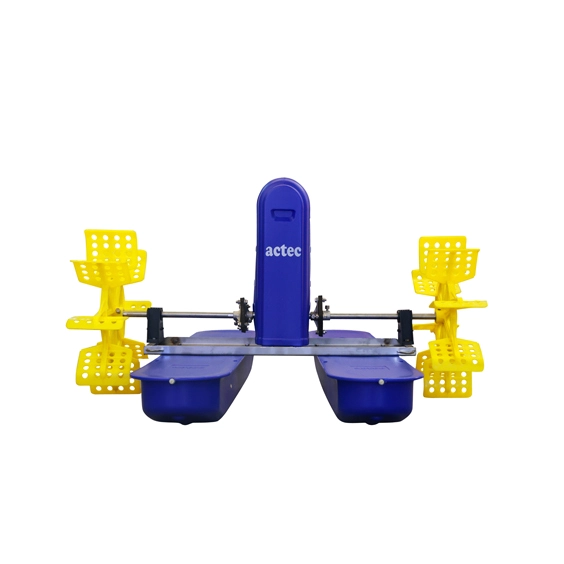
| Aerator Size | Main Advantage | Potential Limitation | Typical Use |
| 1 HP | Flexible placement and localized circulation | More units and electrical connections may be required | Small ponds, nursery ponds, and targeted pond zones |
| 2 HP | Practical balance between coverage, power, and unit quantity | Failure of one unit removes more capacity than a 1 HP unit | Commercial shrimp ponds and medium-to-high-density farming |
| 3 HP | Fewer machines needed for high total horsepower | Larger circulation footprint and less placement flexibility | Large ponds and high-aeration-demand zones |
A larger motor does not automatically mean better pond performance. Multiple smaller aerators may produce more even circulation, while fewer larger units may reduce installation and maintenance points.
For projects requiring a wider equipment package, Flojett also provides shrimp farming equipment, including surface aeration and supporting pond-system options.
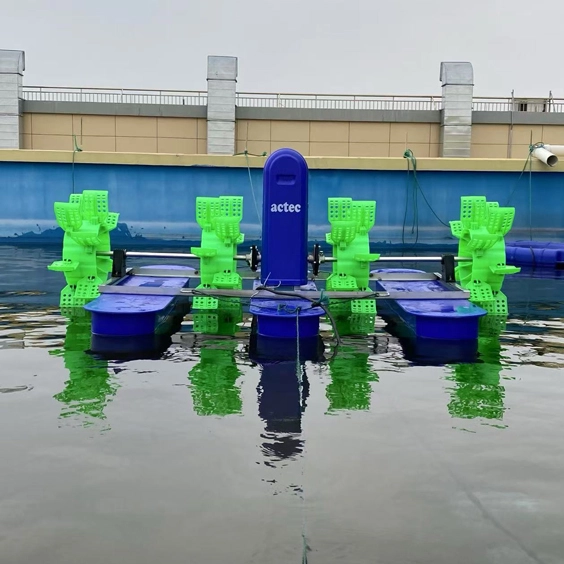
A 2 HP model is one of the most practical configurations for commercial shrimp ponds.
The approximate number can be calculated as:
Number of 2 HP units = required total HP ÷ 2
Examples:
Expected Biomass | Required Capacity | Calculated 2 HP Units | Practical Starting Quantity |
3,000 kg/ha | 6–7.5 HP | 3–3.75 | 3–4 units |
5,000 kg/ha | 10–12.5 HP | 5–6.25 | 5–7 units |
8,000 kg/ha | 16–20 HP | 8–10 | 8–10 units |
10,000 kg/ha | 20–25 HP | 10–12.5 | 10–13 units |
Always round upward when partial units are calculated. It is also advisable to maintain reserve equipment for emergencies and maintenance.
Correct placement creates a circular flow pattern and helps move waste toward a designated central or collection area.
General placement principles include:
Install paddle wheel aerators around the pond perimeter.
Direct water flow in the same rotational direction.
Avoid placing two units so their flows oppose each other.
Maintain circulation in corners and low-flow zones.
Keep equipment accessible for inspection and repair.
Prevent excessive erosion of earthen pond banks.
Adjust placement when sludge accumulates in undesirable areas.
In square or rectangular ponds, paddle wheel aerators are often positioned along the sides or near corners and angled to form a circular current.
The exact arrangement depends on pond shape, water depth, inlet and outlet positions, central drain design, and dominant wind direction.
Paddle wheel aerators are highly useful for surface oxygen transfer and directional circulation, but intensive ponds may benefit from combining surface and bottom aeration.
System | Main Function | Strength | Limitation |
Paddle wheel aerator | Surface oxygenation and horizontal flow | Strong circulation and visible water movement | Less direct aeration at the pond bottom |
Blower with diffusers | Delivers air below the surface | More distributed bubble aeration | Usually creates less directional surface flow |
Combined system | Surface circulation plus bottom aeration | Broader oxygen distribution and operational flexibility | Higher installation cost and system complexity |
The most suitable aquaculture aerator configuration should be selected according to pond depth, expected shrimp biomass, oxygen demand, and the required water-flow pattern.
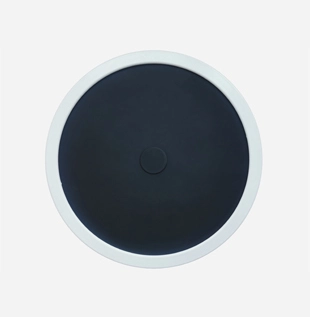
Flojett's surface aeration solutions can combine paddle wheel aerators with blowers, aeration hoses, and diffuser discs where both circulation and bottom oxygenation are required.
Aeration schedules should be based on dissolved oxygen measurements rather than a fixed clock schedule alone.
Shrimp farms commonly face the greatest oxygen risk:
Before sunrise
After several cloudy days
During high water temperatures
After heavy feeding
Late in the culture cycle
During phytoplankton die-off
After rainfall or rapid weather changes
When shrimp biomass approaches harvest level
Low-density ponds may operate aerators mainly at night and during emergencies. Intensive ponds may require extended or continuous operation, especially during the final production stage.
A dissolved oxygen meter should be used at multiple pond locations and depths. Monitoring only near an aerator may produce an overly optimistic reading.
A calculation that gives 20 HP does not necessarily mean the farm should install exactly 20 HP.
Additional reserve capacity provides protection when:
One aerator is undergoing maintenance
A motor or gearbox fails
Oxygen demand exceeds the forecast
Biomass or survival is higher than expected
Weather conditions reduce natural oxygen production
Feeding rates increase
Emergency circulation is required
The reserve percentage should be decided according to production risk, equipment reliability, local weather, and access to replacement machines.
High-density farms should also consider backup electricity, standby generators, or alternative emergency aeration because installed aerators provide no protection during a power outage.
A hectare-based number without biomass information can underestimate the needs of an intensive farm or oversize a low-density pond.
Post-larvae density does not directly equal final biomass. Survival and target shrimp size must be included.
Aeration capacity should be designed for the highest expected oxygen demand near harvest.
Horsepower indicates power input, not actual oxygen-transfer efficiency or water-flow performance.
Adequate total horsepower cannot compensate for poor circulation and stagnant zones.
A farm operating at the exact minimum is more vulnerable to equipment failure and sudden oxygen depletion.
To calculate a suitable paddle wheel aerator configuration, provide:
Pond length and width
Average and maximum water depth
Shrimp species
Stocking density
Expected survival rate
Target harvest size
Target harvest biomass
Maximum daily feeding rate
Salinity range
Local voltage and frequency
Existing aeration equipment
Preferred motor power
Pond layout or drawing
Destination country or port
Based on this information, Flojett can help select the motor power, impeller quantity, total number of units, and approximate placement strategy.
The number depends primarily on expected shrimp biomass. A commonly used starting guideline is approximately 1 HP of mechanical aeration for every 400–500 kg of expected harvest biomass. A pond targeting 5,000 kg/ha may therefore require around 10–12.5 HP.
For a pond requiring 10–12.5 HP, approximately five to seven 2 HP aerators would be needed. Intensive ponds targeting 10,000 kg/ha may require approximately 10–13 units, subject to actual pond conditions and equipment performance.
Four units may be enough for some moderate-density ponds, depending on the horsepower of each machine and expected shrimp biomass. Four 2 HP units provide 8 HP, which corresponds to a preliminary production estimate of roughly 3,200–4,000 kg under the 400–500 kg/HP guideline.
Excessive or poorly positioned aeration may increase electricity costs, disturb pond bottoms, erode banks, or move sludge into undesirable areas. Aeration should be sized and positioned according to biomass, oxygen demand, and pond hydraulics.
Not every pond requires continuous operation. Lower-density ponds may use scheduled nighttime aeration, while intensive systems may need extended or continuous aeration. Dissolved oxygen monitoring should determine the operating schedule.
They are commonly installed around the pond perimeter and directed to create a consistent circular water flow. Placement should prevent opposing currents, stagnant corners, and excessive bank erosion.
There is no single correct number of paddle wheel aerators per hectare for every shrimp pond.
The most practical starting method is to calculate installed aeration capacity from expected harvest biomass:
Approximately 1 HP of mechanical aeration per 400–500 kg of expected shrimp biomass.
Using this guideline:
3,000 kg/ha may require about 6–7.5 HP.
5,000 kg/ha may require about 10–12.5 HP.
8,000 kg/ha may require about 16–20 HP.
10,000 kg/ha may require about 20–25 HP.
These figures must then be adjusted for pond depth, stocking density, feeding rate, water temperature, salinity, aerator efficiency, circulation requirements, and backup capacity.
Flojett supplies paddle wheel aerators and supporting aquaculture aeration equipment for commercial shrimp farms. Send us your pond dimensions, stocking plan, expected harvest biomass, and electrical requirements to receive a model recommendation and project-based quotation.


 English