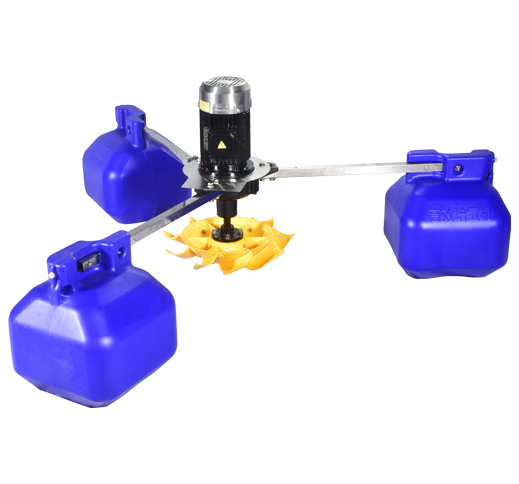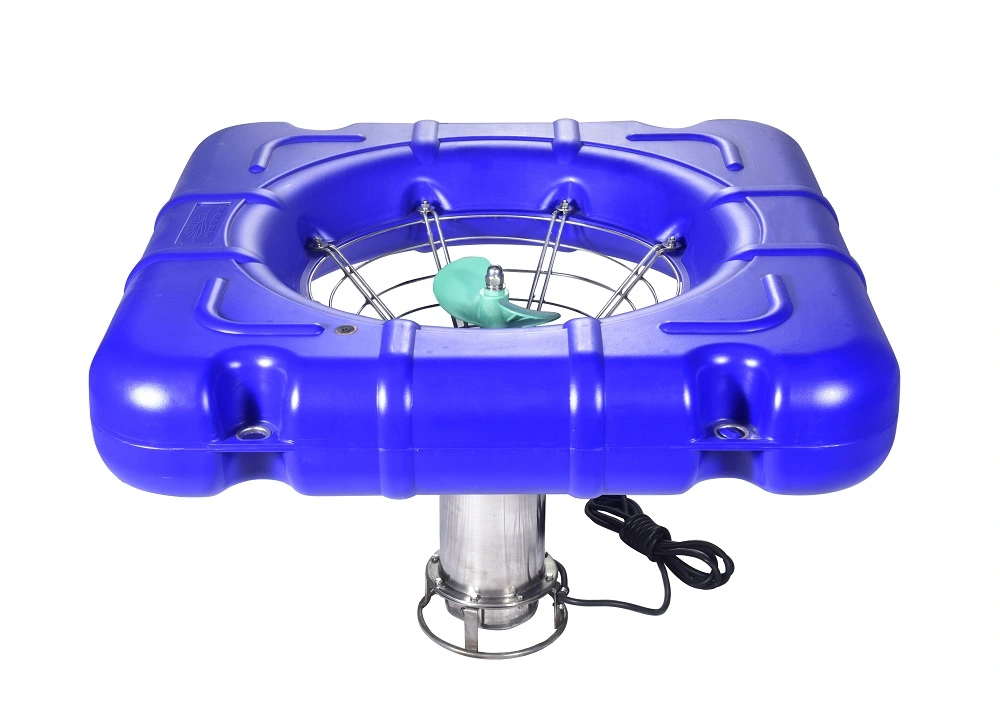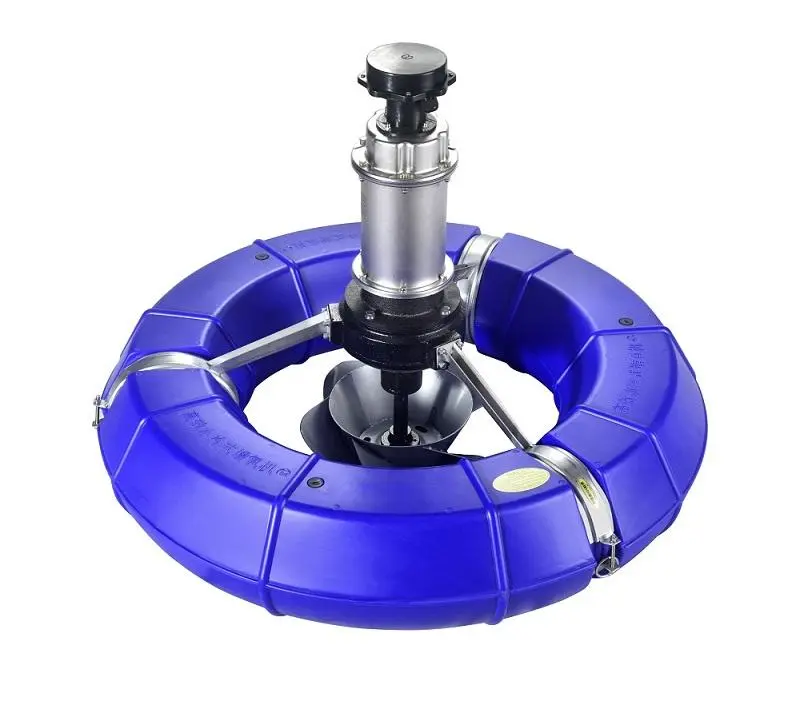
The Flojett FJ-WS is a water-cooled surge aerator designed for fish farming, aquaculture ponds, and wastewater treatment applications. Its compact structure combines a high-efficiency motor, planetary gear reducer, stainless steel impeller, and UV-resistant HDPE round float.
During operation, pond water helps dissipate heat from the motor and gearbox, supporting stable performance during extended use. With its lightweight design and strong surface agitation, the FJ-WS is suitable for tilapia tanks, fish ponds, and other small- to medium-scale aeration systems.
Below are some features of our water cooling surge aerators:
High performance: Gear box with high performance planetary gear inside ensure high transmitting, make the gears working more smoothly and improve the durability and longevity.
High quality material: Main parts includes motor and impeller are made of stainless steel 304, the float is made from 100 % new HDPE with anti-UV, these materials can ensure the aerator under harsh environments.
High efficiency: High efficiency motor, planetary gears in gear box, flower-shaped spiral impeller design, bring the air into water and splash the water increased the dissolved oxygen. Meanwhile, it can help exchange the water up and down, improve the water oxygen at pond bottom.
Less cost: Compared with some other types of aerators, inverted water cooling splash aerator has relatively less parts, make it less purchasing cost and less maintenance cost. It is really an ideal choice for aquaculture farming.
Simple Operation and Lightweight: Less components can be set up easily.Light weight can be installed and moved conveniently.
| Parts details & specifications of FJ-SW series | ||
| Part name | detail & specification | Qty |
| Motor+gear box | assembled/planetary gears/H Grade Insulation | 1 |
| Float | 100% new HDPE with anti-UV | 1 |
| Impeller | S.S 304 | 1 |
| Support frame | S.S 304 | 3 |
| Bolt kit | S.S 304 | 1 bag |
| Model | Power | Voltage (V) | Frequency (HZ) | Aeration performance (kg O₂/Hour ) | Consumption (A) | Weight (KG) | Qty in 20GP/40HC |
| FJ-SW | 1.5kW /2HP | 110-440 | 50/60 | ≥2.6 | 3.2A/7.8A | 33 | 100/220 |
*Rated current depends on the voltage, phase and electrical configuration. Please confirm the required power supply before ordering.
A surge aerator uses a rotating spiral impeller to draw water upward and discharge it above the pond surface. The rising water breaks into droplets and waves, increasing the contact area between water and atmospheric air.
As the oxygenated water returns to the pond, the continuous upward and outward flow also creates surface circulation. This combination of splashing and water movement can help:
Increase dissolved oxygen
Release accumulated gases at the surface
Reduce stagnant zones near the aerator
Improve local water circulation
Support fish and shrimp during periods of high oxygen demand
Unlike an air blower system, the FJ-WS does not require separate air pipes or diffusers. It produces oxygen transfer through mechanical surface agitation.
The FJ-WS surge aerator can be used for surface oxygenation and circulation in:
Fish farming ponds
Shrimp and prawn ponds
Tilapia ponds and tanks
Aquaculture nursery ponds
Small and medium-sized grow-out ponds
Emergency aeration during hot weather
Water circulation in treatment ponds or lagoons
The required number of aerators depends on pond size, water depth, stocking density, species, biomass, feeding rate and local climate. Equipment selection should not be based on motor power alone.
The FJ-WS is suitable for aquaculture operators who need a lightweight surface aerator with a simple installation structure.
Key reasons to choose this model include:
Compact single-float design
2 HP motor configuration
Stainless steel impeller and support frame
UV-resistant HDPE float
No separate blower or diffuser pipes required
Convenient movement between pond locations
Surface aeration combined with visible water circulation
For larger ponds or applications requiring a stronger horizontal flow pattern, a paddle wheel aerator may be a more suitable option.
Comparison | Surge Aerator | Paddle Wheel Aerator |
Main aeration method | Lifts and splashes water upward | Churns water horizontally with rotating paddles |
Water movement | Concentrated upward surge and surface waves | Strong horizontal surface circulation |
Structure | Compact, usually with one round float | Longer frame with multiple floats and impellers |
Installation | Lightweight and easy to reposition | Requires more assembly and pond space |
Typical use | Localized surface aeration and smaller pond zones | Broader circulation in medium and large ponds |
Maintenance | Relatively few components | More shafts, bearings and paddle components |
Neither type is universally better. The appropriate aerator depends on pond dimensions, required circulation pattern, oxygen demand and installation conditions.
A surge aerator is a mechanical surface aerator that uses a rotating impeller to lift and splash water above the surface. This increases air-to-water contact and creates visible water circulation.
The impeller and support frame are made from 304 stainless steel, while the round float uses virgin HDPE with UV resistance.
A surge aerator primarily pushes water upward to create splashing and localized surface circulation. A paddle wheel aerator produces a stronger horizontal flow pattern using several rotating paddles.
No. The FJ-WS creates aeration mechanically through water movement and does not require a separate blower, air hose or diffuser.
The quantity depends on pond area, depth, stocking density, species, feeding rate and target dissolved oxygen. Flojett should calculate the configuration using actual pond conditions.



 English